

Establishing a Resilient AI Governance Framework
The transition from experimental AI pilots to enterprise-scale production requires a shift in focus from mere performance to systemic accountability. As the regulatory landscape matures, particularly with the finalization of the European Union AI Act, organizations must move beyond informal guidelines. A robust AI governance framework is no longer a discretionary corporate social responsibility initiative; it is a mandatory requirement for any enterprise operating within the European single market or impacting its citizens.
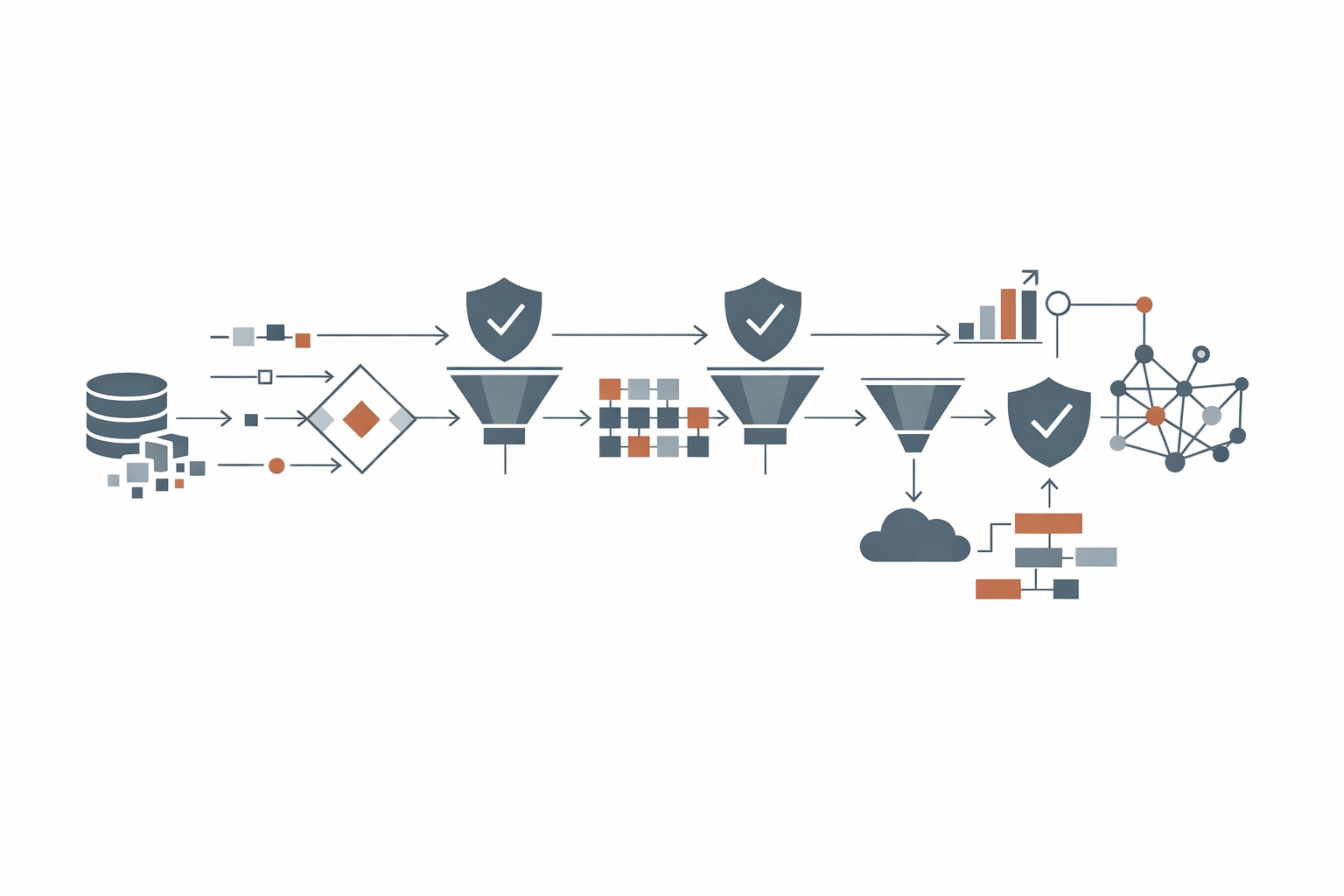
For Chief Technology Officers and data leaders, the primary challenge lies in creating a framework that is both rigorous enough to survive a third-party audit and flexible enough to support rapid innovation. This requires integrating compliance directly into the machine learning lifecycle, from initial data procurement to post-market monitoring. At CONAIS, we advocate for an engineering-first approach to governance where policy is reflected in code and metadata.
Aligning with the EU AI Act Risk Tiers
The foundation of any modern AI governance framework must be the risk-based approach defined by the EU AI Act. This regulation categorizes AI systems into four tiers: prohibited, high-risk, limited risk, and minimal risk. Most enterprise applications in retail, finance, and human resources fall under the high-risk category if they influence critical decision-making or use sensitive biometric data. Identifying these classifications early is essential to avoid retroactive compliance costs.
Article 6 of the AI Act defines the criteria for high-risk systems. Organizations must establish a classification protocol that evaluates the intended purpose of every model. Before deploying a new solution, leadership should utilize a formal AI Readiness Test to determine the regulatory burden associated with the specific use case. This early assessment dictates the level of documentation, transparency, and oversight required throughout the development process.
Risk Management Systems under Article 9
Article 9 of the AI Act mandates that high-risk AI systems must have a continuous, iterative risk management system. This is not a one-time assessment performed at the start of a project. Instead, it is a systematic process that persists throughout the entire lifecycle of the AI system. The risk management system must identify and analyze the known and foreseeable risks associated with each model, including potential misuse and unintended outcomes.
Technical leaders must implement automated triggers for risk re-evaluation. For instance, if a model’s performance metrics drift beyond a predefined threshold or if the underlying data distribution changes significantly, the risk management plan must be updated. This ensures that the governance framework remains responsive to the dynamic nature of machine learning environments.
Data Governance and Quality Requirements
Data quality is the most significant technical hurdle for audit-grade compliance. Article 10 of the AI Act specifies that training, validation, and testing datasets for high-risk AI systems must be subject to appropriate data governance and management practices. This includes examining the original data collection process, identifying potential biases, and ensuring that the data is sufficiently representative of the population it affects.
To survive an audit, enterprises must provide evidence of data lineage and provenance. Every transformation, cleaning step, and augmentation must be logged. When using cloud ecosystems like Azure AI Foundry, organizations can leverage built-in tools to track these assets, but the policy layer must be defined by the internal governance team. We often help clients define these standards within our broader AI solutions and consulting services to ensure that data lakes do not become compliance liabilities.
Technical Documentation and Record Keeping
Transparency is a core pillar of the EU AI Act. Article 11 and Annex IV require detailed technical documentation that proves the system complies with all regulatory requirements. This documentation must include a description of the system’s architecture, its design specifications, and the logic used for its algorithms. For deep learning models, where internal logic is often non-linear, the focus shifts to documenting the training methodologies and the architectural choices made by the data science team.
Furthermore, Article 12 requires high-risk systems to incorporate automatic logging capabilities. These logs must record the period of each use of the system, the input data used, and the individuals involved in the decision-making process. This “audit trail” is what a regulator will inspect during a conformity assessment. Without automated logging, manual record-keeping will inevitably fail under the scale of enterprise operations.

Operationalizing Human Oversight
Article 14 emphasizes that high-risk AI systems must be designed in a way that allows for effective human oversight. The goal is to prevent or minimize the risks to health, safety, or fundamental rights that may emerge when an AI system is used. This oversight must be performed by individuals who have the necessary competence, training, and authority to intervene. This includes the ability to disregard or override the output of the AI system when necessary.
In an enterprise context, this means building human-in-the-loop (HITL) workflows into the application architecture. For example, in automated document processing, any confidence score below a certain percentile should automatically route the task to a human reviewer. These interventions must also be logged to demonstrate that the oversight mechanism is active and effective rather than a passive checkbox exercise.
Integrating Governance into Azure AI Foundry
For organizations utilizing Microsoft’s stack, the AI governance framework can be operationalized through Azure AI Foundry and Copilot Studio. These platforms provide features for model monitoring, data lineage, and content filtering. However, the software alone does not constitute a framework. The enterprise must define the specific policies, sensitivity labels, and approval workflows that these tools will enforce.
Strategic implementation involves mapping the requirements of the EU AI Act text (Official Journal of the EU) directly to the technical configuration of the cloud environment. This ensures that every model deployed through the central hub automatically inherits the organization’s governance standards. This vendor-agnostic approach to policy ensures that even if the underlying technology changes, the governance principles remain consistent.
Moving Toward Audit Readiness
Audit readiness is achieved when an organization can produce an unbroken chain of evidence for every decision an AI system makes. This requires a transition from siloed data science teams to a cross-functional governance committee including legal, IT, and business stakeholders. Practical examples of these frameworks in action can be found in our various AI implementation use cases, where we bridge the gap between regulatory theory and technical execution.
The final step in the governance journey is the appointment of an AI compliance officer or a similar role responsible for signing off on conformity assessments. This individual acts as the point of contact for national supervisory authorities and ensures that the organization stays updated on the evolving standards issued by the EU AI Office.
Implementing Your AI Governance Strategy
Building an AI governance framework is an iterative process that begins with a clear understanding of your current risk exposure. Enterprises that address these requirements now will gain a significant competitive advantage over those forced to halt operations due to non-compliance when the AI Act’s grace periods expire. Governance should not be viewed as a barrier to innovation, but as the structural integrity that allows innovation to scale safely.
If your organization is looking to formalize its approach to responsible AI or needs assistance preparing for the technical requirements of the EU AI Act, CONAIS provides the strategic advisory and engineering expertise to guide the transition. Our focus is on building audit-grade systems that protect your enterprise while maximizing the utility of your AI investments. Reach out to our team to discuss your current architecture and compliance roadmap.
Frequently asked questions
What are the primary requirements for high-risk AI under the EU AI Act?
High-risk AI systems must implement a risk management system, maintain detailed technical documentation, ensure high data quality, enable human oversight, and provide automatic logging for traceability.
How can enterprises automate AI governance documentation?
Enterprises can automate documentation by using MLOps platforms like Azure AI Foundry to track model lineage, data versions, and performance logs, which serve as the basis for Annex IV technical files.
What is the role of human oversight in AI governance?
Human oversight ensures that individuals can monitor AI operations, detect anomalies, and override automated decisions to prevent risks to safety or fundamental rights, as required by Article 14 of the AI Act.