

Artificial intelligence is moving from experimentation to execution. Every enterprise is searching for a scalable, secure and governed approach to building AI applications — one that brings together data, models, copilots and responsible AI under a unified strategy.
Microsoft’s answer to this challenge is AI Foundry, a new foundation layer designed to help organizations build, deploy and manage AI systems with consistency and control. For leaders navigating the growing complexity of cloud and AI ecosystems, AI Foundry acts as the connective tissue that brings all Microsoft AI capabilities together.
This article explains what AI Foundry is, how it fits into the Microsoft ecosystem, and why it matters for enterprise transformation.
Why AI Foundry Matters Now
The enterprise AI landscape has matured rapidly:
- AI initiatives have moved beyond pilot projects.
- Companies need repeatable frameworks, not isolated models.
- Governance, security and compliance are now non-negotiable.
- Data and model fragmentation slow down innovation.
- New AI roles (LLMOps, prompt engineering, internal copilots) require structured workflows.
Many organizations are realizing the same truth:
AI requires a platform, not just a set of tools.
AI Foundry emerges at this moment as a system that streamlines how enterprises adopt, scale and govern AI — without needing to stitch together dozens of disconnected components.
What Is Microsoft AI Foundry?
AI Foundry is Microsoft’s integrated platform for building, evaluating, deploying and governing AI systems across the enterprise.
It combines:
- the model catalog
- training and fine-tuning workflows
- evaluation and prompt testing tools
- deployment and monitoring pipelines
- and enterprise-grade governance & compliance
…into one unified environment.
Foundry is not “just another AI tool.”
It is the strategic layer that turns Microsoft’s AI ecosystem into a coherent platform for enterprise innovation.
How AI Foundry Fits Into the Microsoft Ecosystem
To understand AI Foundry’s value, leaders must see where it sits in the broader Microsoft architecture.
AI Foundry + Azure AI Studio
Azure AI Studio is where teams build and experiment with models.
AI Foundry provides the standards, governance and lifecycle management that make those models enterprise-ready.
Think of it as:
AI Studio = creation environment
AI Foundry = enterprise AI operating model
AI Foundry + Microsoft Fabric
Fabric is Microsoft’s data backbone.
AI Foundry connects directly into this foundation, enabling AI models to train on governed enterprise data in OneLake and use unified semantic models.
This solves a major challenge:
data–model misalignment — a common blocker in enterprise AI adoption.
AI Foundry + Azure Machine Learning
For ML teams building classical ML models, Azure ML continues to be the workbench.
AI Foundry becomes the overarching governance and catalog layer that unifies ML and LLM operations under one lifecycle.
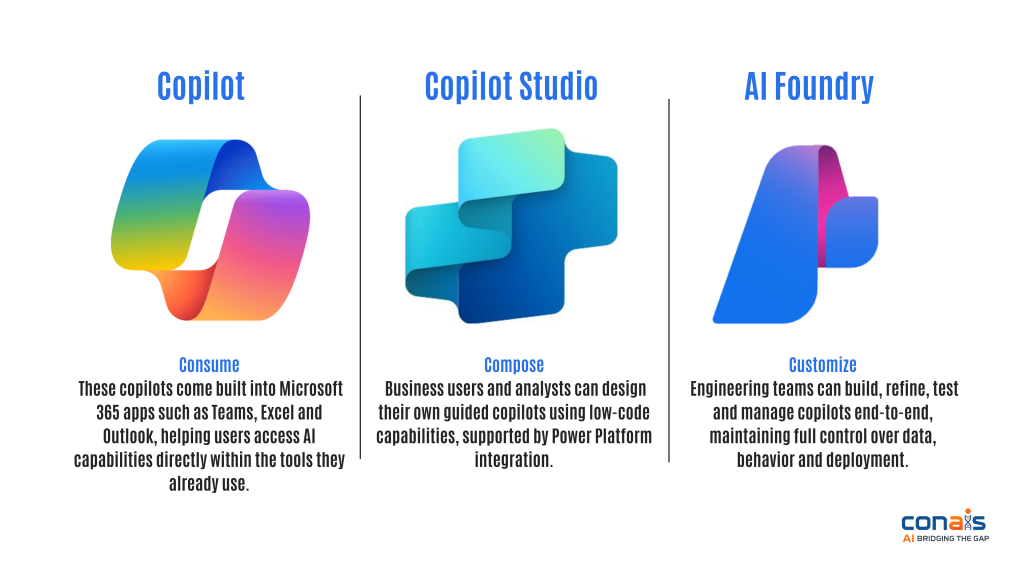
AI Foundry + Copilot & Copilot Studio
Copilots represent AI’s most visible enterprise use case.
AI Foundry provides the model origin, approval workflow, evaluation and deployment governance behind those copilots.
In short:
Copilot is the interface. Foundry is the engine and control layer behind it.
Core Capabilities of AI Foundry
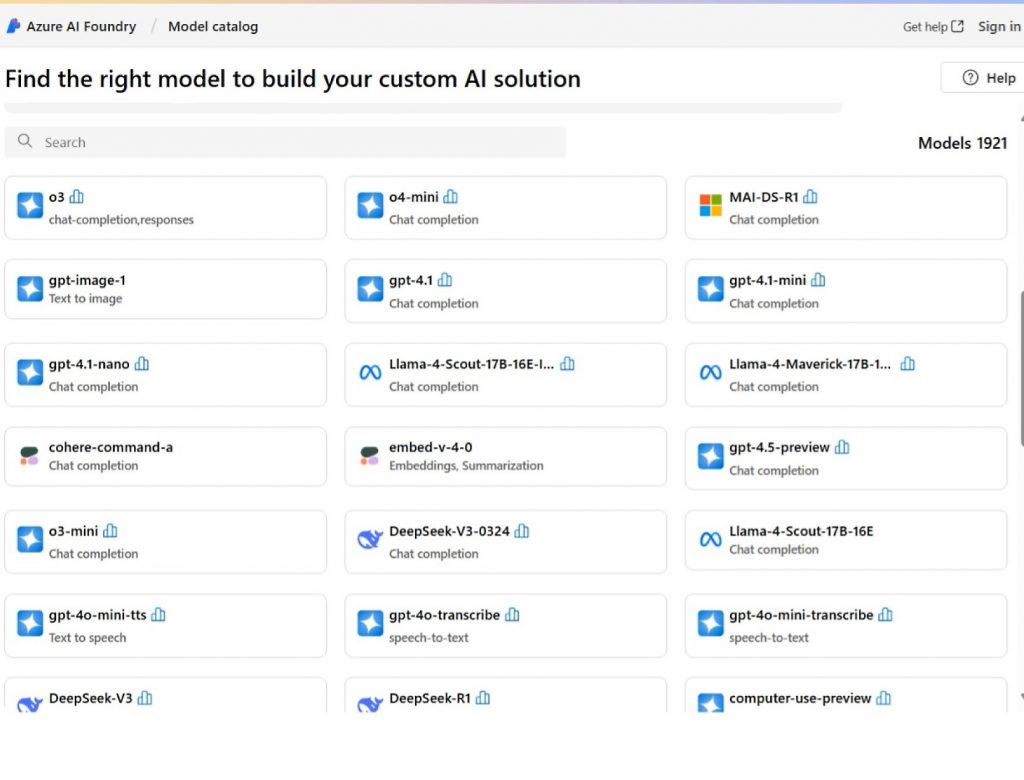
Unified Model Catalog
Centralized access to Microsoft, open-source and custom models — all managed under corporate governance.
Training & Fine-Tuning
Support for custom training pipelines, domain adaptation and secure enterprise datasets.
Evaluation & Safety Testing
Built-in tools to test model behavior, quality, alignment and responsible AI compliance.
Prompt Engineering & Scenario Testing
Systematic prompt workflows with version control, templates and multi-scenario evaluation.
This reduces the “trial and error” nature of prompt creation.
Enterprise Governance Layer
Controls covering:
- approvals
- usage rights
- model access
- logging & audit
- compliance reporting
This is foundational for regulated industries.
Lifecycle Management
Models move from development → evaluation → approval → deployment in a controlled and observable manner.
Integration with Enterprise Data
Native connection to Fabric, OneLake, Microsoft Graph and other data sources ensures models are grounded in trusted data.
Why AI Foundry Is Important for Organizations
Leaders choose AI Foundry because it answers the four biggest enterprise AI challenges:
1. Fragmentation
AI Foundry unifies data, models, copilots and workflows into one ecosystem.
2. Governance & Compliance
It provides a secure framework for AI risk management — essential for regulated sectors.
3. Time-to-Value
With reusable templates and standardized workflows, teams move from idea to deployment faster.
4. Enterprise AI Maturity
Foundry supports an organization’s evolution from early experimentation to scalable AI operations.
The result is simple:
more control, less risk, faster innovation.
AI Foundry vs Traditional AI Development
Before Foundry, many enterprises faced:
- ad-hoc experimentation
- siloed teams and duplicated models
- inconsistent governance
- unclear ownership
- difficulty moving prototypes into production
AI Foundry replaces this with:
- standardized model lifecycles
- centralized visibility
- shared evaluation frameworks
- integrated security and compliance
- unified tooling across LLMs and ML models
This is the difference between “doing AI projects” and operating AI as a strategic capability.
Enterprise Use Cases for AI Foundry
AI Foundry enables a wide range of scenarios:
Enterprise Knowledge Copilots
Search, summarization and knowledge extraction across internal data.
Customer Service Automation
Multi-turn assistants integrated with CRM, ticketing and backend systems.
Process Intelligence & Automation
AI systems that optimize workflows, augment employees or automate repetitive tasks.
Industry-Specific AI
Retail demand forecasting, financial compliance copilots, manufacturing quality systems, healthcare triage assistants, and more.
Model Governance at Scale
For large organizations running dozens of models, Foundry acts as the single source of truth.
How to Get Started with AI Foundry
Leaders should take a staged approach:
- Define the business outcomes (not the technology first).
- Assess enterprise data readiness via Fabric and existing repositories.
- Choose the right models from the AI Foundry catalog.
- Set up governance early — approval flows, access rights, compliance.
- Start with one high-impact use case, then scale horizontally.
- Integrate monitoring and evaluation from day one.
This structured approach reduces risk and accelerates adoption.
AI Foundry + ConAIs: Strategic Partnership Approach
ConAIs helps organizations build AI ecosystems that are secure, compliant and aligned with business strategy.
Our approach includes:
- enterprise AI readiness assessment
- AI Foundry architecture and integration
- governance & responsible AI frameworks
- custom model lifecycle design
- Fabric + Foundry + Copilot alignment
- quick-start accelerators for fast deployment
We partner with leaders to turn AI Foundry into a scalable AI operating model, not just a technical tool.
Conclusion
AI Foundry represents a pivotal step in Microsoft’s vision: an end-to-end platform that connects data, models, copilots and governance. For enterprise leaders, it provides clarity, structure and scalability — the key ingredients for long-term AI success.
Organizations that adopt Foundry early will be positioned to build AI systems that are secure, compliant and deeply integrated into their workflows. Those who wait will find themselves managing fragmented tools in an increasingly governed world.
ConAIs is here to help enterprises navigate this shift with clarity, speed and strategic alignment.
