AI transformation has become one of the most widely used—and most misunderstood—terms in today’s enterprise agenda. Many organizations believe they are transforming simply because they have adopted AI tools, launched pilots, or deployed generative models across a handful of functions. In reality, very few are transforming at all.
True AI transformation is not driven by technology upgrades. It is driven by organizational change. It reshapes how decisions are made, how work is executed, and how value is created at scale. Without this shift, AI remains an isolated capability rather than a strategic advantage.
What AI Transformation Really Means for Enterprises
AI transformation is the process of redesigning an organization’s operating model so that artificial intelligence becomes a core component of decision-making, workflows, and execution—not an add-on.
Unlike traditional digital transformation, which focuses on digitizing existing processes, AI transformation challenges the processes themselves. It asks whether work should be done differently when prediction, automation, and reasoning are embedded directly into daily operations.
For enterprises, this means moving beyond experimentation toward repeatable, governed, and value-driven use of AI across functions. The goal is not more models, but better outcomes.
Why Most AI Transformation Initiatives Fail to Scale
Despite significant investment, most AI transformation efforts stall after early pilots. The reason is rarely technical.
Organizations often begin with tools instead of problems. AI initiatives are launched without clear ownership, without redesigning workflows, and without aligning incentives or success metrics. Teams build impressive proofs of concept that never survive contact with real operational complexity.
Another common failure point is leadership distance. When AI is treated as an IT initiative rather than a business transformation, it lacks the authority required to change how decisions are made or how teams work. Without executive ownership, AI remains peripheral.
AI Transformation Is an Operating Model Shift, Not an IT Project
At its core, AI transformation is about changing how the organization operates.
In transformed organizations, AI does not sit beside workflows; it is embedded within them. Decisions that once relied solely on human judgment are augmented with predictive signals. Processes that were sequential become adaptive. Feedback loops shorten, and accountability becomes clearer.
This shift requires rethinking roles, responsibilities, and governance. Humans remain accountable, but AI becomes a trusted collaborator—supporting speed, consistency, and scale without replacing judgment.
Organizations that succeed understand that AI transformation is not about deploying systems. It is about redesigning how work gets done.
The Core Building Blocks of Successful AI Transformation
Successful AI transformation rests on a small number of interconnected foundations.
Leadership and ownership are essential. Transformation requires visible executive sponsorship, clear decision rights, and alignment between strategy and execution. Without leadership commitment, organizational inertia will always win.
Data and decision infrastructure must support real-time insight and action. AI cannot transform operations if it is fed fragmented, low-quality, or inaccessible data.
Workflow redesign is where value is unlocked. AI must be integrated into the moments where decisions are made and work is executed, not layered on top as an optional tool.
Governance and trust enable scale. Clear standards around risk, accountability, and oversight ensure AI can be deployed responsibly without slowing innovation.
Finally, workforce enablement and change management determine adoption. Transformation succeeds only when people understand, trust, and use AI as part of their everyday work.
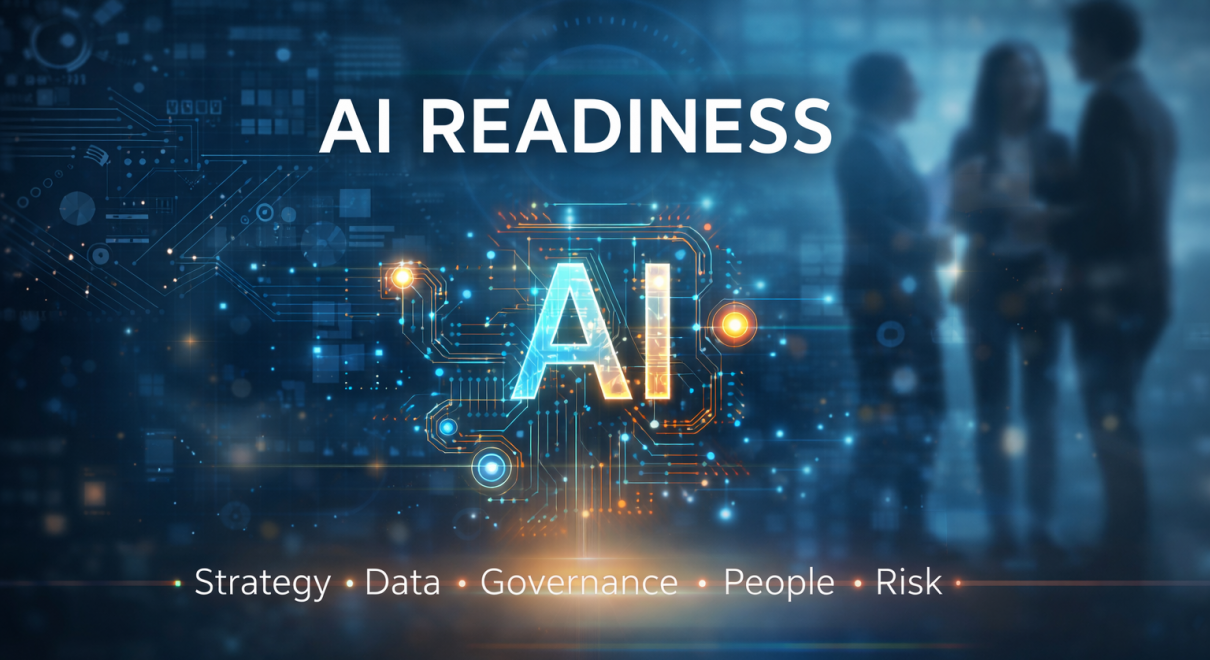
From AI Readiness to AI Transformation
AI readiness prepares an organization for transformation. AI transformation puts that readiness into action.
Readiness focuses on capability: infrastructure, data, skills, and governance. Transformation focuses on behavior: how decisions change, how workflows evolve, and how value is realized.
Organizations that skip readiness struggle to scale. Organizations that stop at readiness never transform. The most successful enterprises treat readiness as the foundation and transformation as the outcome.
What AI Transformation Looks Like in Practice
In practice, AI transformation follows consistent patterns across industries.
Organizations start by targeting high-impact workflows rather than isolated use cases. They embed AI where it can influence outcomes, not just generate insights. Over time, they standardize how AI is developed, deployed, and governed, enabling faster iteration and safer scale.
Most importantly, they measure success through business outcomes—productivity, cost reduction, decision quality—not through technical metrics alone.
Transformation is visible not in dashboards, but in how work actually happens.
Why Governance Defines the Success of AI Transformation
As AI becomes embedded into core operations, governance moves from compliance to strategy.
Without clear governance, AI introduces risk: inconsistent decisions, regulatory exposure, loss of trust. With governance, AI becomes a controlled, auditable, and reliable capability.
Leading organizations design governance that enables speed rather than restricting it. They define guardrails, not bottlenecks. This balance allows AI to scale responsibly while maintaining human accountability and organizational trust.
How ConAIs Approaches AI Transformation
At ConAIs, AI transformation is treated as an organizational challenge, not a tooling exercise.
Our approach starts with strategy and operating model design, aligns data and architecture to decision-making needs, and ensures governance and execution evolve together. We focus on enabling organizations to embed AI into real workflows, not just deploy isolated solutions.
Transformation succeeds when technology, leadership, and execution move in lockstep.
Conclusion
AI transformation is no longer optional. It is the defining capability of organizations that want to remain competitive in an increasingly automated, data-driven world.
The organizations that succeed will not be those with the most advanced models, but those that redesign how decisions are made and work is executed. Transformation requires leadership, discipline, and a willingness to rethink the fundamentals of how the organization operates.
👉 To understand how execution-ready architectures support AI transformation, explore our deep dive on the Model Context Protocol (MCP).