
SharePoint governance is often discussed as policy documentation, site lifecycle management, or permission control. But inside many Microsoft 365 environments, SharePoint governance is something else entirely.
It is accumulated risk.
Over time, workflows are added. Add-Ins are installed. Permissions expand. Azure ACS principals remain active. Remote integrations continue running without visibility. Approval logic is copied, slightly modified, and redeployed.
Nothing breaks.
Until transformation begins.
What many CIOs are now discovering is not a workflow problem. It is SharePoint governance debt.
How SharePoint Governance Debt Quietly Compounds Risk
Unlike infrastructure failures, governance debt inside SharePoint does not announce itself. It compounds silently.
Common patterns include:
- Legacy SharePoint 2013 workflows running without documentation
- Over-permissioned app principals with tenant-wide scope
- Azure ACS remnants still active inside Microsoft 365
- Remote event receivers tied to unknown dependencies
- Duplicated approval logic across departments
- SharePoint Add-Ins never reassessed after deployment
Each of these elements works independently. Together, they create fragility inside the collaboration layer.
When Microsoft retires legacy components such as SharePoint 2013 workflows and the Add-In model, organizations often assume the retirement is the disruption.
In reality, weak SharePoint governance is the underlying issue.
What SharePoint Governance Debt Looks Like at the Executive Level
At CIO level, SharePoint governance debt appears across three critical dimensions.
1. Identity and Permission Exposure
Many legacy Add-Ins relied on Azure ACS–based authentication. Permissions were often granted broadly for convenience.
Years later, few organizations can clearly explain:
- Which app principals remain active
- What permission scopes they hold
- Whether those scopes are still justified
Poor SharePoint governance is not only operational risk. It is a security risk.
2. Automation Opacity
Workflows built in SharePoint Designer or embedded in legacy automation layers frequently lack ownership and oversight.
If a compliance approval chain fails tomorrow:
- Who owns the logic?
- Who maintains the flow?
- Can the process be audited?
Automation without governance creates opacity.
Opacity creates executive exposure.
3. Architectural Drift
As enterprises scale, SharePoint evolves organically. Teams solve immediate problems with local solutions.
Over time, this produces:
- Fragmented automation architecture
- Inconsistent extensibility models
- Mixed authentication approaches
- No centralized orchestration
Architectural drift is one of the most expensive forms of governance debt.
Why Retirement Milestones Exposed SharePoint Governance Weakness
The retirement of SharePoint 2013 workflows and SharePoint Add-Ins did not create governance debt.
It revealed it.
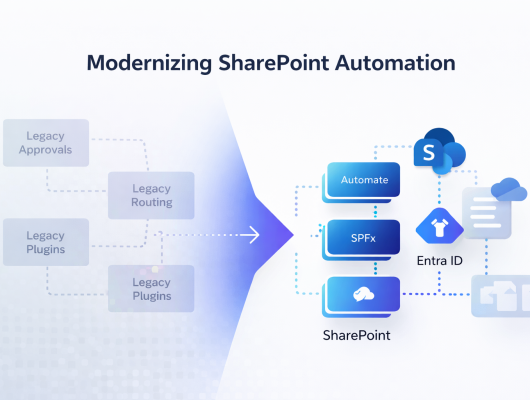
Microsoft 365 is consolidating around:
- SharePoint Framework (SPFx)
- Microsoft Entra ID
- Graph-first APIs
- Event-driven integration models
Legacy extensibility patterns no longer align with this direction.
Organizations that accumulated governance debt are now facing structural modernization decisions.
SharePoint governance is no longer an IT hygiene topic. It is an architectural leadership topic.
The 6 Hidden Risks of Weak SharePoint Governance
Strong SharePoint governance protects collaboration environments. Weak governance amplifies risk.
Here are six executive-level risks:
1. Security Overexposure
Over-scoped permissions and legacy authentication models increase attack surface inside Microsoft 365.
2. Automation Fragility
Undocumented workflows break under modernization pressure.
3. Compliance Blind Spots
Without governance visibility, demonstrating audit traceability becomes difficult.
4. Increased Technical Debt
Rebuilding outdated logic without redesign compounds architectural complexity.
5. AI Readiness Blockage
AI systems require structured permissions, documented workflows, and event transparency. Weak SharePoint governance limits AI scalability.
6. Reactive Transformation Costs
Organizations that delay governance cleanup face higher consulting, remediation, and downtime costs when forced to act.
SharePoint governance debt does not disappear. It accumulates until transformation exposes it.
SharePoint Governance and AI Readiness
Enterprise AI initiatives increasingly depend on:
- Clean identity models
- Transparent workflow logic
- Structured event triggers
- API-consistent integration layers
- Governed automation architecture
You cannot deploy AI agents effectively on top of undocumented automation and uncontrolled permissions.
AI amplifies architecture.
If SharePoint governance is weak, AI scales fragility.
As we have explored in our broader AI adoption strategy discussions, infrastructure readiness is the most underestimated variable in successful AI deployment.
Strong SharePoint governance is foundational to AI readiness inside Microsoft 365.
A Practical SharePoint Governance Reset Framework
CIOs looking to address SharePoint governance debt should consider a structured reset.
1. Automation Inventory
Identify all workflows, Add-Ins, and remote event receivers. Map business criticality.
2. Identity Cleanup
Audit Azure ACS principals. Remove excessive scopes. Align authentication to Entra ID.
3. Extensibility Standardization
Consolidate on SPFx and modern development patterns.
4. Permission Governance Model
Define approval pathways for automation deployment and permission grants.
5. Observability and Monitoring
Ensure workflow execution, access grants, and integration calls are auditable.
6. AI-Alignment Review
Evaluate whether collaboration architecture supports AI-driven automation safely.
This is not a migration task. It is governance normalization.
From SharePoint Governance to Enterprise Control
Strong SharePoint governance reduces:
- Security exposure
- Operational fragility
- Compliance risk
- Modernization friction
Weak SharePoint governance amplifies all of them.
SharePoint is not merely a document repository. It is an operational backbone inside Microsoft 365.
If that backbone carries hidden governance debt, transformation initiatives will inherit it.
The question for CIOs is not whether governance debt exists.
The question is whether it will be addressed proactively or discovered under pressure.
How ConAIs Supports SharePoint Governance Modernization
At ConAIs, we help enterprise leaders diagnose and eliminate SharePoint governance debt before it becomes transformation friction.
We support organizations by:
- Auditing SharePoint governance maturity
- Assessing workflow and Add-In exposure
- Redesigning identity and permission architecture
- Standardizing extensibility on SPFx
- Aligning collaboration environments with AI-ready infrastructure
SharePoint governance is no longer a technical afterthought.
It is a strategic infrastructure decision.
If your Microsoft 365 environment is carrying legacy automation, fragmented permissions, or undocumented extensibility layers, now is the time to evaluate governance readiness.
Modern AI-driven enterprises are built on clean governance foundations.