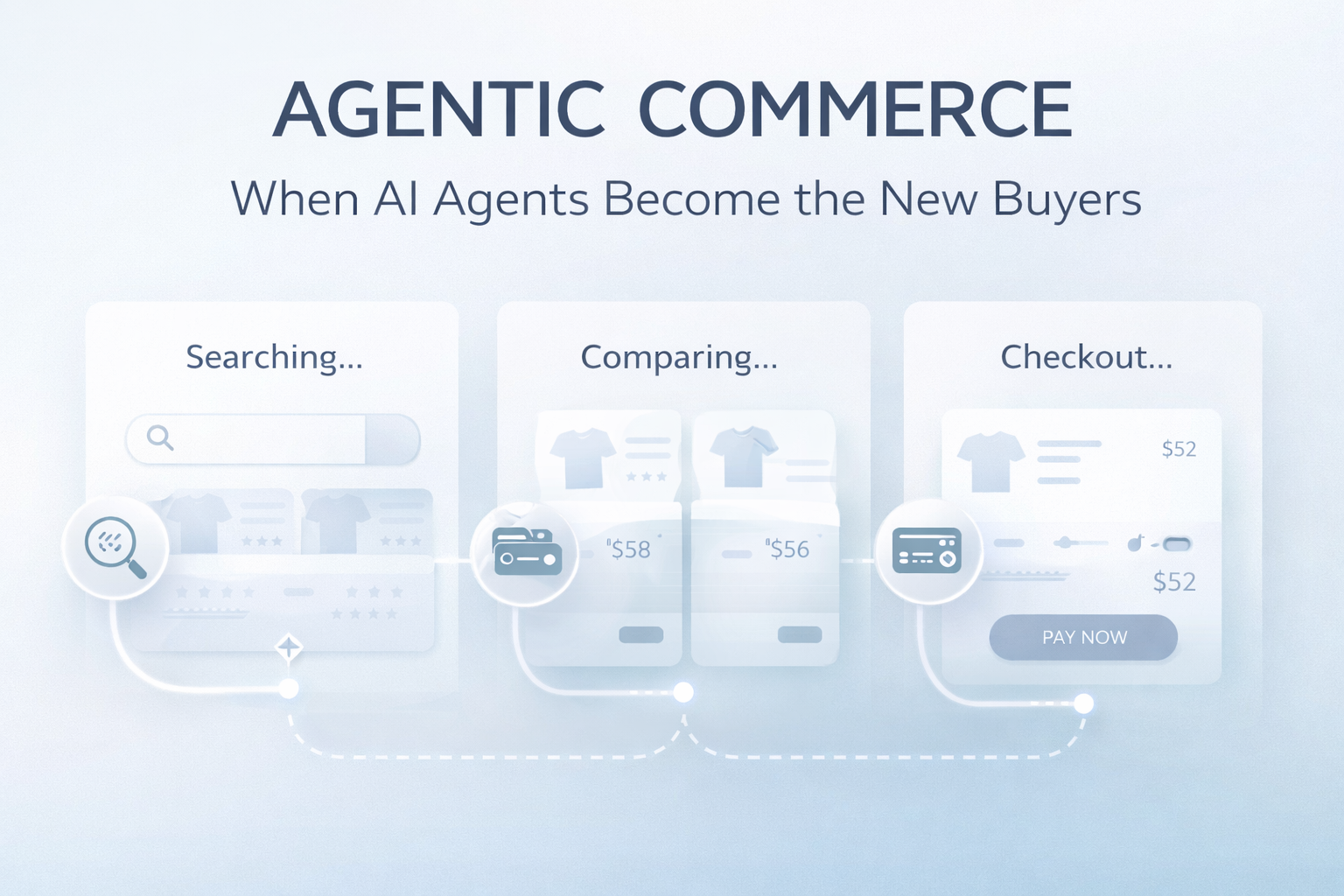
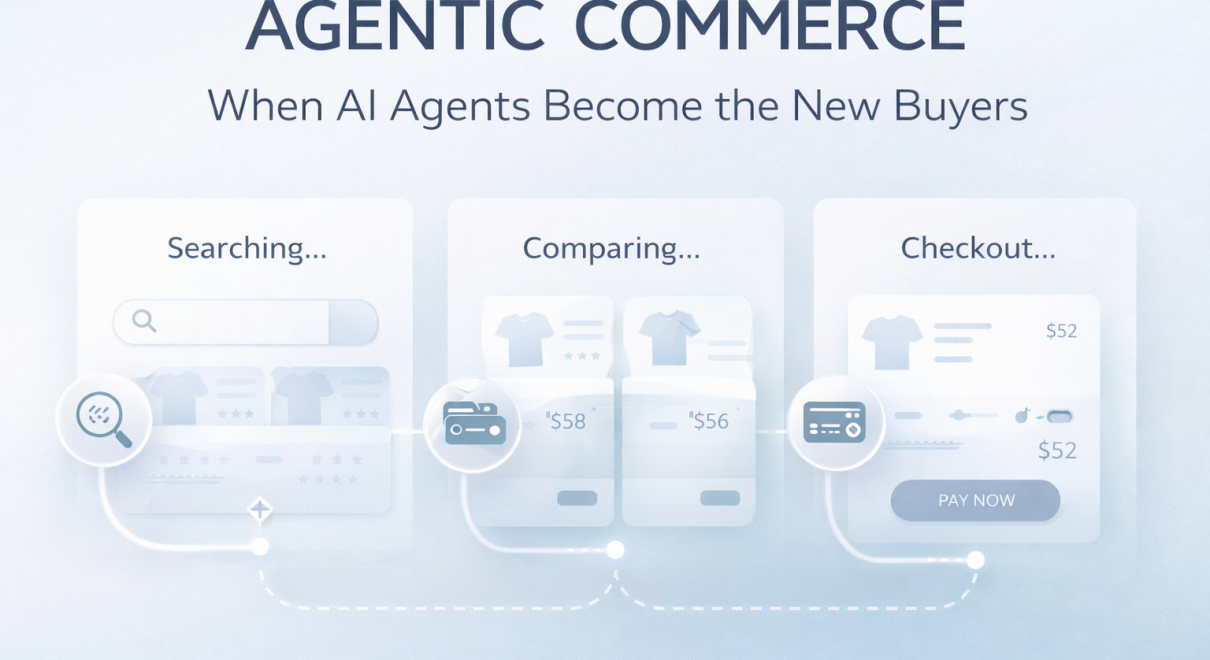
Commerce is undergoing a structural shift that goes far beyond better recommendations or faster checkout flows. For decades, digital commerce has been designed around one assumption: humans search, compare, decide, and click. That assumption is now breaking.
Agentic commerce represents a new phase in which autonomous AI agents act on behalf of consumers and businesses—discovering products, evaluating options, negotiating trade-offs, and executing transactions with little or no human intervention. This is not a marginal improvement to e-commerce. It is a redefinition of who makes buying decisions and how markets function.
For leaders, the question is no longer whether agentic commerce will arrive. It is whether their organization will be visible and relevant when it does.
From E-Commerce to Agentic Commerce
The evolution of commerce closely mirrors the evolution of AI itself.
Predictive AI helped businesses forecast demand and recommend products. Generative AI accelerated content creation, customer support, and personalization. Agentic AI goes further. It does not simply assist—it acts.
In agentic commerce, AI systems are no longer passive tools waiting for prompts. They are goal-driven actors capable of pursuing outcomes, adapting to changing conditions, and coordinating multiple steps across systems. Instead of optimizing parts of the shopping journey, they can own the journey end to end.
This marks a transition from interface-driven commerce to intent-driven commerce. What matters is no longer how attractive a website is, but how well a business can be understood, evaluated, and transacted with by machines.
What Makes Agentic Commerce Fundamentally Different
Traditional e-commerce AI is reactive. Chatbots answer questions. Recommendation engines suggest products. Copilots assist employees when asked.
Agentic commerce is proactive. Agents identify needs, plan actions, and execute them autonomously within defined boundaries. They reason across data sources, handle multi-step tasks, and adjust decisions in real time.
The difference is not incremental sophistication—it is autonomy. Once autonomy enters the system, control shifts. Decisions that were once made by humans, guided by brands and interfaces, increasingly move to AI systems optimizing for price, availability, relevance, and constraints.
That shift changes the rules of competition.
Why Agentic Commerce Changes the Balance of Power
In an agent-mediated market, your most important customer may no longer be a person. It may be an AI agent acting on someone’s behalf.
This has profound implications. Agents prioritize utility over emotion. They compare relentlessly. They do not browse for inspiration or loyalty—they optimize. Brands that rely on storytelling, habit, or visual appeal alone risk being deprioritized by systems that value structured data, reliability, and execution speed.
Without deliberate action, retailers and service providers risk being reduced to background utilities in agent-controlled marketplaces. Visibility shifts upstream to the platforms and agents that control discovery and decision-making. Direct relationships weaken. First-party data becomes harder to retain.
Agentic commerce does not eliminate brands—but it forces them to compete on new terms.
The Rise of AI Shopping Agents
This shift is already underway.
AI agents embedded in platforms like ChatGPT, Perplexity, and Google Gemini are increasingly influencing how products are discovered and purchased. Consumers are growing comfortable delegating research, comparison, and even checkout to AI systems that promise speed and relevance.
As trust increases, agents will move from assisting decisions to completing them. Product discovery, price evaluation, inventory checks, payment, and post-purchase support will increasingly happen within conversational interfaces—often without a visit to a traditional website.
The result is a compressed funnel. Fewer steps. Less friction. Less room for manual influence.
Inside an Agentic Commerce System
At a high level, agentic commerce systems share a common structure.
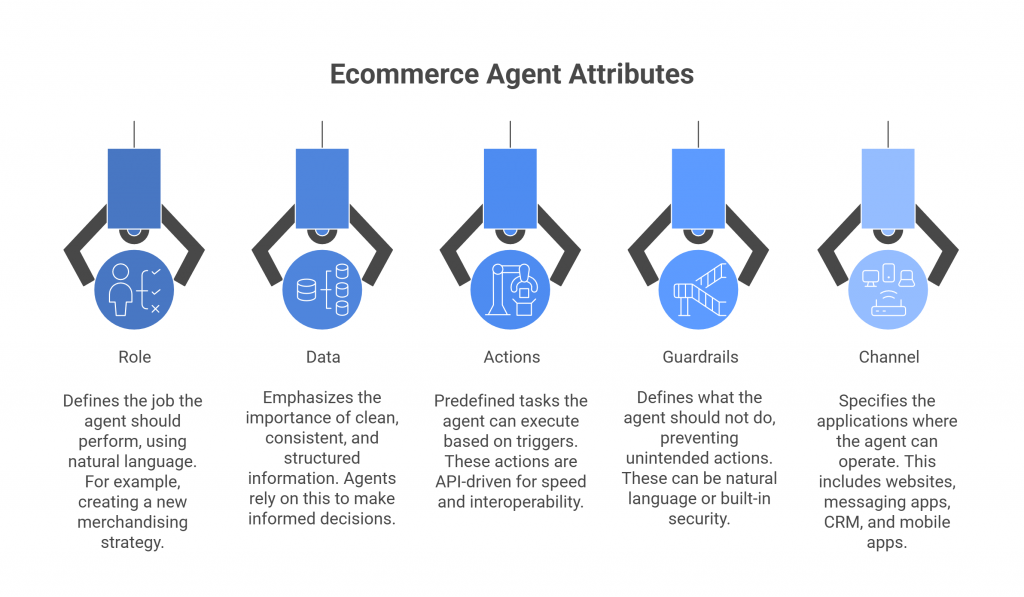
Agents are assigned clear roles—what they are responsible for achieving. They rely on trusted, machine-readable data to understand products, prices, availability, and constraints. They execute actions through robust, API-driven workflows that connect commerce, payment, marketing, and fulfillment systems.
Equally important are guardrails. Agents must operate within defined boundaries, escalating to humans when necessary and respecting security, compliance, and brand rules. Finally, agents work across channels—web, mobile, messaging apps, CRM systems, and internal tools—wherever commerce interactions occur.
The effectiveness of agentic commerce depends less on intelligence alone and more on how well these components are structured and governed.
Why Protocols Matter in Agentic Commerce
As autonomy increases, standardization becomes essential.
Agentic commerce cannot scale on custom integrations and brittle workflows. It requires shared languages that allow agents and businesses to understand each other securely and consistently.
This is where emerging protocols play a critical role. The Model Context Protocol (MCP) provides a standardized way for AI agents to discover capabilities, understand context, and interact safely with back-end systems. Building on this foundation, the Agentic Commerce Protocol (ACP) defines how agents and businesses coordinate transactions—covering discovery, checkout, and secure payment execution.
Together, these protocols enable open, interoperable commerce flows where businesses retain control while remaining accessible to a growing ecosystem of AI agents.
👉 For a deeper look at how MCP enables execution-ready AI systems, see our dedicated article on the Model Context Protocol (MCP).
What Agentic Commerce Means for Businesses
Agentic commerce introduces both risk and opportunity.
The risk is disintermediation. Businesses that are invisible to agents—or difficult for them to evaluate—will lose relevance regardless of brand strength. Data fragmentation, opaque pricing, and closed systems become competitive liabilities.
The opportunity lies in readiness. Businesses that make their offerings agent-readable, their operations agent-accessible, and their governance agent-safe can reach high-intent buyers at unprecedented scale. Agentic commerce opens new acquisition channels, reduces friction, and enables continuous optimization driven by real-time demand.
The difference between the two outcomes is strategic preparation.
How Leaders Should Respond Now
Agentic commerce is not a problem for the future. It is a design challenge for today.
Leaders should begin by making their data and content machine-readable and consistent. Product information, pricing, inventory, and policies must be structured so agents can interpret them reliably.
Checkout, payment, and fulfillment systems should be designed to support secure, programmatic access. Governance frameworks must define what agents are allowed to do, when they must escalate, and how accountability is maintained.
Finally, organizations must adapt their operating models. In an agentic world, humans set direction and constraints, while AI systems execute at speed and scale. That requires new skills, new controls, and a clear understanding of where autonomy adds value—and where it does not.
Conclusion
Agentic commerce is not a feature upgrade. It is a new market architecture.
As buying decisions shift from humans to machines, visibility, control, and value creation will be redistributed. Organizations that prepare for this shift will remain discoverable, relevant, and competitive. Those that do not risk becoming invisible—present in the supply chain but absent from the decision.
The era of agent-driven commerce has already begun. The question for leaders is whether they will shape it—or be shaped by it.