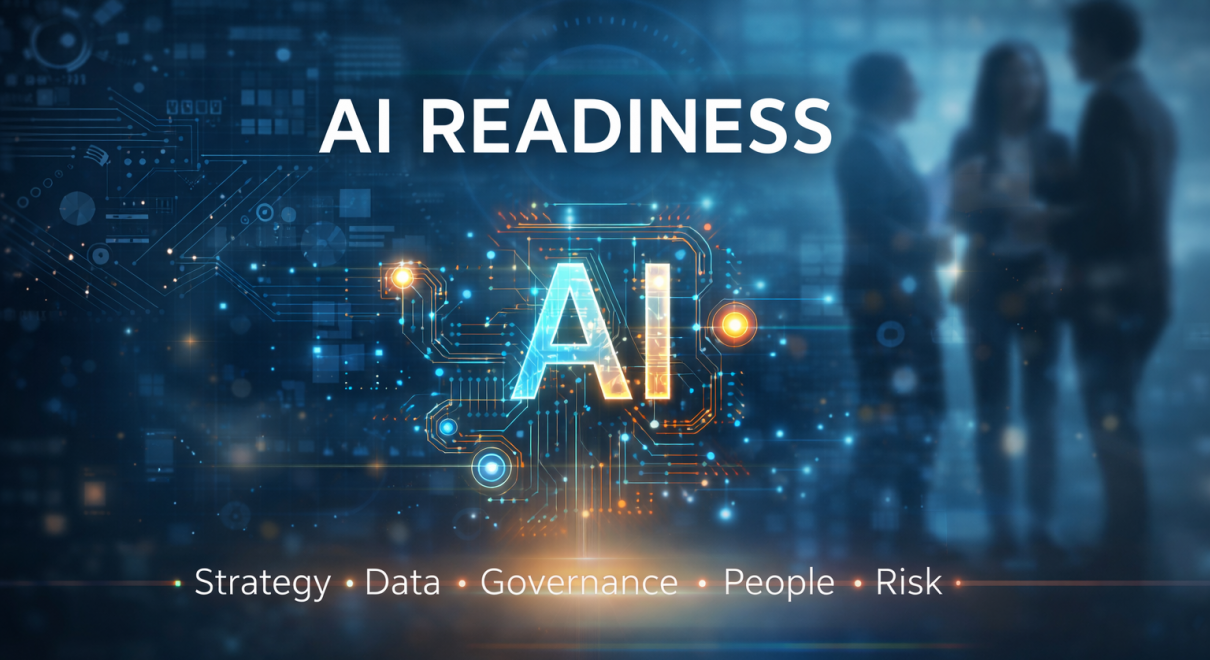
AI adoption is no longer the challenge. Nearly every organization today is using artificial intelligence in at least one business function, and a growing majority are experimenting with generative AI. Yet despite this widespread adoption, very few companies manage to translate AI activity into sustained, measurable business impact.
This gap is not accidental. It reflects a deeper issue that many leaders underestimate: AI readiness.
AI readiness determines whether artificial intelligence becomes a scalable operating capability or remains an expensive collection of pilots. In 2025 and beyond, the winners will not be those with the most advanced models, but those with the strongest organizational foundations.
AI Readiness Is a Leadership Problem, Not a Technology One
AI is often framed as a technical initiative. As a result, responsibility is delegated to IT, data science, or innovation teams. This framing almost guarantees failure at scale.
The most consistent finding across enterprise AI research is simple: organizations where senior leadership actively owns AI governance and prioritization outperform those where AI is treated as a side project. When accountability is unclear, AI initiatives fragment across departments, compete for resources, and stall before reaching production.
AI reshapes how decisions are made, how risk is managed, and how work is performed. These are leadership questions. Treating AI readiness as anything less than a leadership responsibility is one of the most common—and costly—mistakes organizations make.
What AI Readiness Really Means in 2026
AI readiness is often misunderstood as having the right tools, the right cloud infrastructure, or access to large datasets. While these elements matter, they are only part of the picture.
At its core, AI readiness is an organization’s ability to consistently generate business value from AI without compromising security, governance, or operational stability.
This requires balance. Organizations must align ambition with accountability, experimentation with discipline, and innovation with trust. AI readiness is not a single milestone; it is an operating state that enables AI to move from experimentation into everyday business execution.
Why Most AI Initiatives Fail Before They Scale
The majority of AI programs fail for reasons that have little to do with model performance.
Data is often fragmented across silos, making integration slow and unreliable. Governance frameworks are introduced late, after risk has already accumulated. Business teams and technical teams operate in parallel rather than together. Success metrics focus on experimentation rather than outcomes. Adoption is assumed instead of measured.
Without readiness, every new AI use case increases complexity rather than value. Scaling becomes harder, not easier.
The Foundations That Actually Define AI Readiness
Across industries and geographies, the same readiness patterns emerge. Organizations that scale AI successfully share a small number of foundational characteristics.
First, clear strategic ownership. AI initiatives are anchored to business priorities, with executive sponsorship and defined success metrics.
Second, strong data and architectural foundations. Data is governed, accessible, and contextualized. Architecture supports integration, observability, and cost discipline rather than isolated experimentation.
Third, an operating model designed for AI. Cross-functional teams co-design workflows where AI is embedded into daily work, not bolted on as a side tool.
Fourth, governance that enables trust. Risk management, compliance, and human oversight are built into systems from the start, not retrofitted after deployment.
Finally, a workforce prepared to work with AI. AI literacy, role-based training, and cultural adoption are treated as strategic investments rather than afterthoughts.
These elements, taken together, explain why some organizations generate ROI from AI while others do not.
AI Readiness vs. AI Maturity
AI readiness and AI maturity are often conflated, but they answer different questions.
AI readiness asks whether an organization is prepared to scale AI responsibly and effectively. AI maturity describes how advanced current AI capabilities are. Maturity without readiness is fragile. Readiness without maturity is an opportunity.
Organizations that focus first on readiness build a foundation that allows maturity to grow sustainably over time.
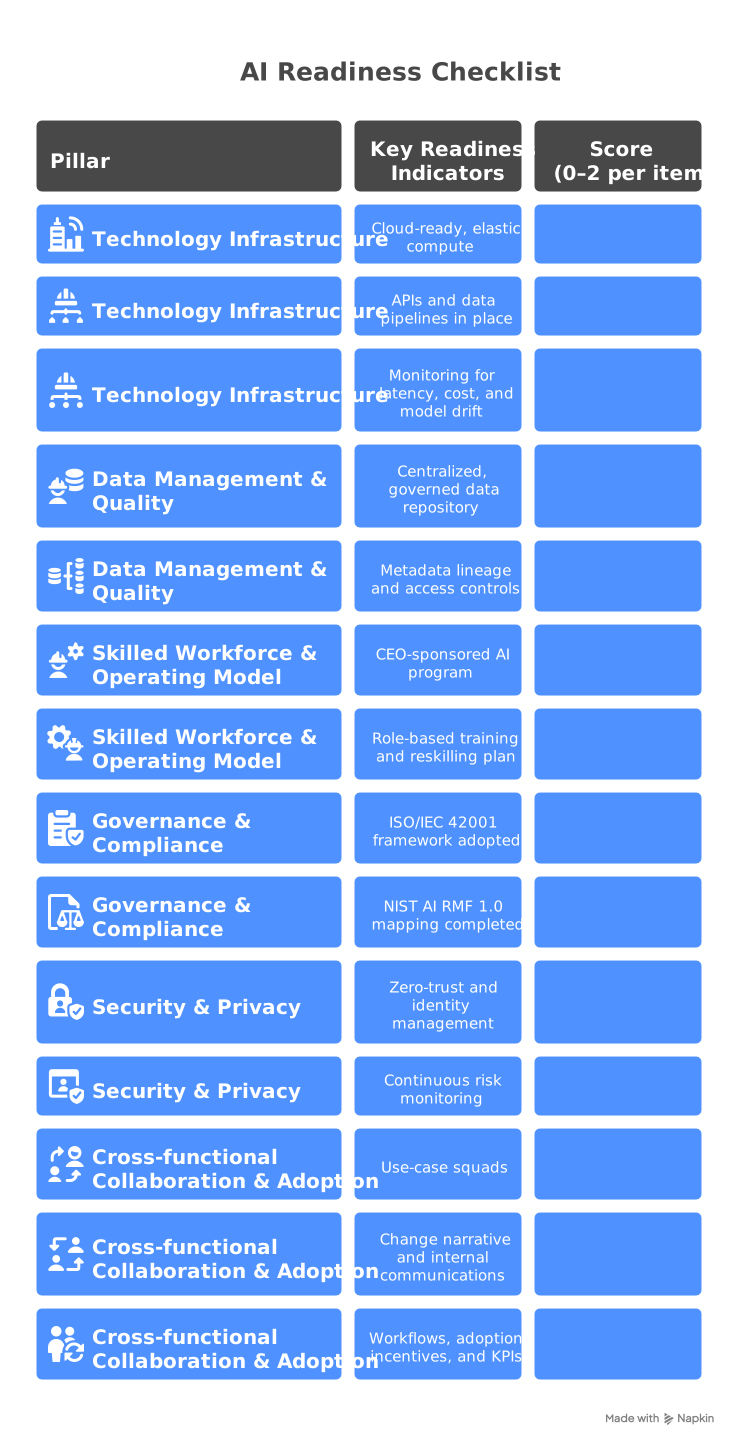
A Condensed AI Readiness Diagnostic
While AI readiness cannot be reduced to a checklist alone, a structured diagnostic can help organizations identify gaps and prioritize action. Below is a condensed readiness snapshot that captures the highest-leverage signals seen across successful AI programs.
Strategy & Leadership
- Executive ownership of AI priorities and governance
- Clear link between AI initiatives and business KPIs
Data & Architecture
- Governed, accessible data with defined ownership
- Scalable infrastructure with observability for cost, latency, and reliability
Operating Model
- Cross-functional AI delivery teams aligned around workflows
- Defined path from experimentation to production
Governance & Risk
- Documented intended use, human-in-the-loop controls, and incident response
- Alignment with emerging AI regulations and standards
People & Adoption
- Role-based AI training across technical and business teams
- Measured adoption and usage, not assumed value
Organizations scoring strongly across these dimensions are far more likely to convert AI investment into measurable outcomes.
Why AI Readiness Determines ROI
The same AI tools can produce radically different results depending on readiness. Organizations with strong readiness move faster, deploy more safely, and adapt more effectively. Those without it struggle to justify continued investment despite growing AI usage.
In practice, AI ROI is driven less by model choice and more by organizational discipline. Adoption, workflow integration, and governance are the true multipliers of value.
From Readiness to Execution
Readiness is only valuable if it informs action. High-performing organizations translate readiness insights into structured implementation roadmaps. They sequence use cases strategically, invest in change management, and continuously measure both value and risk.
AI implementation is not a one-time project. It is an ongoing cycle of learning, feedback, and refinement. Organizations that treat it as such build durable advantage.
How ConAIs Helps Organizations Build AI Readiness
At ConAIs, we work with organizations that want to move beyond experimentation and into execution. Our approach focuses on building AI readiness as a long-term capability—aligning leadership, strengthening data and architecture foundations, embedding governance, and enabling teams to adopt AI with confidence.
We help organizations turn readiness into momentum, and momentum into measurable impact.
Conclusion
AI readiness is the difference between experimentation and execution. It determines whether artificial intelligence remains a collection of isolated pilots or becomes a reliable, enterprise-wide capability embedded into daily operations.
As organizations progress from readiness toward scale, a critical question inevitably emerges: how do AI systems interact safely and consistently with real-world data, tools, and enterprise applications?
This is where architectural foundations begin to matter. Standards such as the Model Context Protocol (MCP) are designed to bridge the gap between AI models and operational systems, enabling agents to discover capabilities, access governed data, and execute actions in a controlled and scalable way. For organizations serious about operationalizing AI, readiness must ultimately translate into execution-ready architectures.
AI will continue to advance regardless of organizational comfort. The real differentiator will not be access to models, but the ability to deploy them responsibly, predictably, and at scale.
👉 To explore how AI readiness evolves into agent-ready execution, read our deep dive on the Model Context Protocol (MCP).