Data has become one of the most valuable assets for modern enterprises — but where that data physically lives now determines who governs it, who can access it, and how companies must protect it. As organizations expand globally, adopt multi-cloud architectures, and integrate AI systems into critical operations, understanding data sovereignty is no longer optional. It is a core requirement for legal compliance, enterprise risk management, and responsible AI deployment.
This article explains the concept clearly, cuts through jargon, and outlines actionable guidance for decision-makers navigating today’s complex regulatory environment.
What Is Data Sovereignty?
Data sovereignty means that data is subject to the laws and governance rules of the country where it is physically stored.
If your organization stores data in Germany, it must comply with EU GDPR. If your backups sit in the U.S., the data may fall under the CLOUD Act. If analytics workloads run in Singapore, APAC requirements may apply. In a world of distributed cloud infrastructures, this creates both legal complexity and strategic implications for enterprises.
Data sovereignty answers a simple but powerful question:
“Which government has the authority over my data?”
Why Data Sovereignty Matters Today
Data sovereignty affects nearly every part of enterprise operations. Its importance has accelerated due to several global shifts:
Rising regulatory pressure
Governments worldwide are tightening data protection laws (GDPR, KVKK, CCPA, LGPD). Violations bring heavy fines, legal exposure, and reputational harm.
Cloud and AI dependency
As organizations adopt multi-cloud, SaaS, and generative AI, their data often moves across borders without being fully visible to internal teams.
Cross-border risk
Even if a company is not operating globally, its vendors, cloud regions, and AI tools might be — creating hidden compliance risks.
Customer trust and security
Enterprises increasingly compete on the strength of their data governance posture. Sovereignty is becoming a differentiator.
In short: data sovereignty protects organizations from legal, technical, and geopolitical risk.
Data Sovereignty vs Data Residency vs Localization
These terms are often confused, but they govern different aspects of how data is handled:
Data Sovereignty
Who controls the data?
→ Data must comply with the laws of the country where it is stored.
Data Residency
Where is the data stored?
→ A business chooses a location for performance, compliance, or strategic reasons.
Data Localization
Is the data required to stay inside national borders?
→ Some countries legally mandate local storage (for example, financial or healthcare data).
Simple summary:
- Residency = optional location
- Localization = mandatory location
- Sovereignty = applicable laws
Understanding these distinctions is essential for designing compliant, scalable cloud and AI systems.
Challenges in Cloud and AI
Data sovereignty becomes significantly more complex when cloud providers and AI systems are involved.
1. Multi-cloud fragmentation
Data may be split across regions depending on where different services run. Logs, backups, model weights, and user data may reside in different jurisdictions.
2. SaaS ambiguity
Enterprises often do not know where SaaS applications physically store or process their data.
3. Generative AI opacity
LLM providers may train, fine-tune, or log prompts in locations not disclosed by default. Without controls, sensitive data may cross borders unintentionally.
4. Third-party access risk
Foreign governments may legally request access to data stored within their jurisdiction.
5. Encryption and key ownership gaps
Even with strong encryption, sovereignty issues persist if a cloud provider controls the keys or can be compelled to hand them over.
For leaders building AI-driven organizations, these risks demand a more intentional approach to data governance.
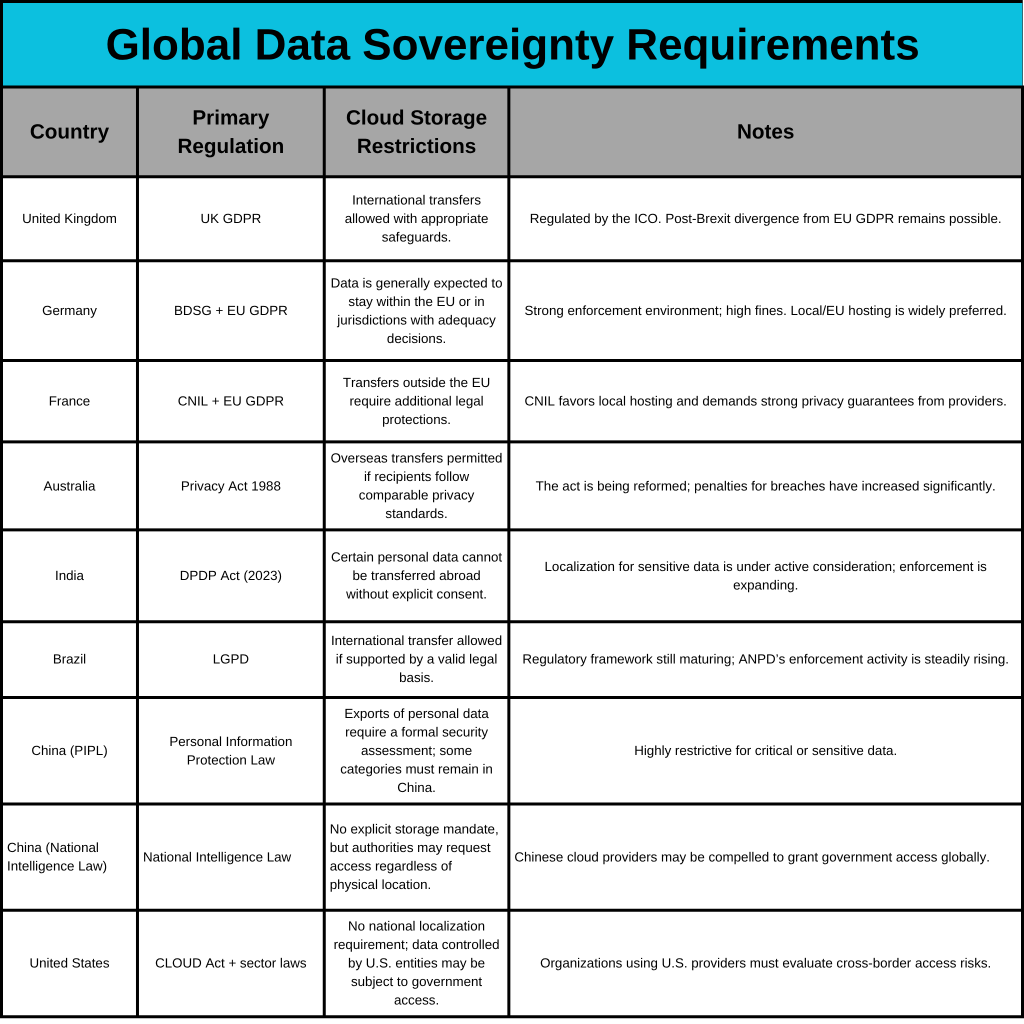
Global Legal Frameworks That Drive Data Sovereignty
Enterprises must navigate overlapping regulations. Key examples include:
GDPR (European Union)
Strict controls on where personal data can be stored and how it can be transferred abroad.
CLOUD Act (United States)
U.S. authorities can request access to data controlled by American companies — even if it is stored overseas.
KVKK (Türkiye)
Regulates the processing of personal data, with restrictions on cross-border transfers.
CCPA/CPRA (California)
Expands consumer rights and imposes transparency requirements on organizations handling personal data.
Data protection laws across APAC, MENA, LATAM
Many regions now mandate local storage for financial, health, or citizen data.
Compliance is no longer a checklist — it is an engineering and architectural discipline.
How Enterprises Can Ensure Compliance
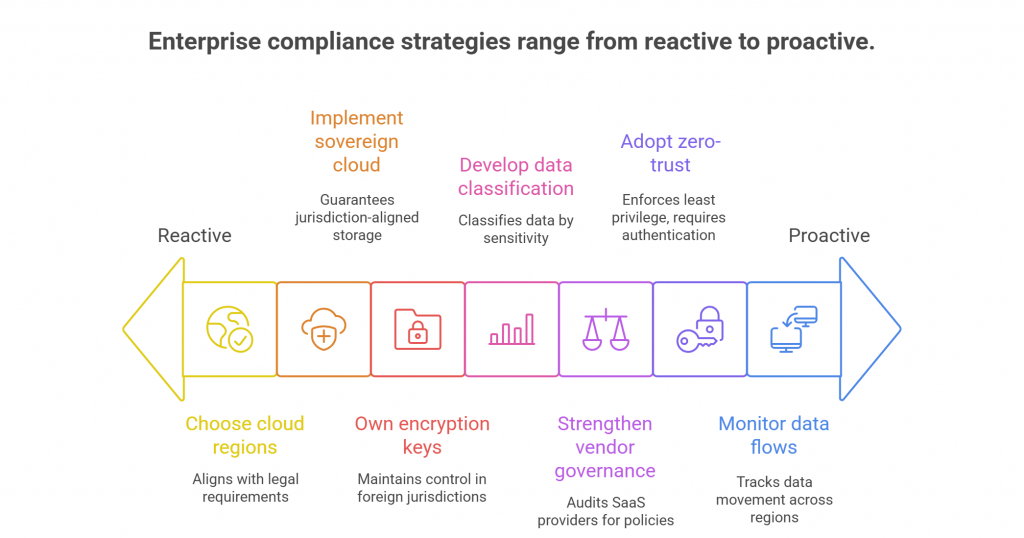
Organizations should move beyond reactive compliance toward proactive data governance. Key strategies include:
1. Choose cloud regions intentionally
Select regions that align with legal requirements, customer expectations, and risk tolerance.
2. Implement “sovereign cloud” patterns
Use isolated environments that guarantee jurisdiction-aligned storage, processing, and key management.
3. Own your encryption keys
Customer-managed keys (CMK) or HSM-backed key management systems help maintain control even in foreign jurisdictions.
4. Build data classification frameworks
Classify data by sensitivity and regulatory constraints before deciding storage locations.
5. Apply strict vendor and AI governance
Audit SaaS providers, AI platforms, and third-party processors for location, access, and retention policies.
6. Use zero-trust principles
Minimize trust boundaries, enforce least privilege, and require continuous authentication.
7. Monitor cross-border data flows
Track how logs, telemetry, analytics jobs, and AI inference requests move across regions.
Effective sovereignty is not about restriction — it’s about visibility, control, and responsible architecture.
The Future of Data Sovereignty
The next decade will redefine how organizations manage data across borders. Trends to watch:
AI-driven governance
Automated systems will classify data, detect sovereignty risks, and enforce policy in real time.
National “AI sovereignty” laws
Countries will regulate not only where data lives, but where AI models may be trained, deployed, or fine-tuned.
Regional cloud ecosystems
Expect more sovereign clouds, national cloud providers, and policy-aligned hyperscaler regions.
Enterprise accountability
Regulators will expect companies to prove — not just claim — that their data governance meets legal standards.
Data sovereignty is moving from a compliance requirement to a strategic capability that affects AI adoption, cloud modernization, and global competitiveness.
Conclusion (and a Note from ConAIs)
Data sovereignty is no longer an abstract legal concept. It sits at the center of enterprise cloud strategy, AI governance, cybersecurity, and global expansion. Organizations that understand and implement sovereignty principles will reduce risk, increase trust, and build more resilient digital ecosystems.
ConAIs helps companies design secure, compliant, and regulation-ready cloud and AI architectures.
Whether you’re modernizing your infrastructure, adopting generative AI, or navigating complex data regulations, our team supports you with clarity and technical depth.
If you’d like help designing a sovereignty-aligned cloud and AI strategy, ConAIs is ready to partner with you.